More optical throughput
A larger effective aperture supports higher brightness and compatibility with multi-mode laser diodes.

Synchronized mirror units create a large effective aperture for laser beam scanning displays and imaging systems.
Prototype / typical values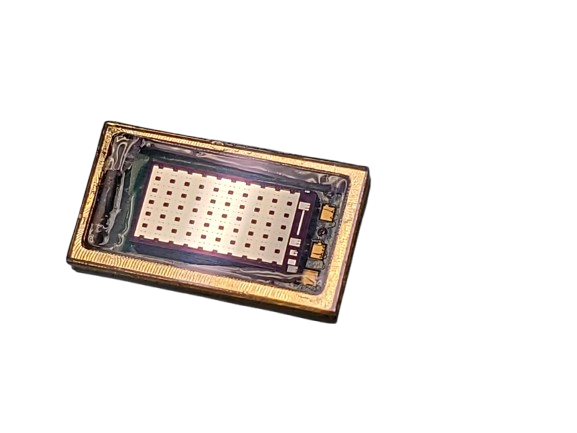
Each mirror unit has its own hinges, anchors and actuators. The units move together at resonance, combining their optical area while keeping each moving element small. Beyond the MEMS scanner, we also provide development services for complete projection systems.
A larger effective aperture supports higher brightness and compatibility with multi-mode laser diodes.
Each unit conducts heat through its hinges and anchors into the substrate.
Use IFM-1D as a resonant fast axis, or combine it with an electromagnetically driven slow axis for hybrid 2D scanning.
We provide development services for complete laser beam scanning projection systems. Work with inSync to develop the entire projector around your application.
Share your projection requirements and integration needs with us. The demonstration shows our current projector in action.
Discuss a projection system ↗Footage from our current projector showing animated color patterns projected onto a building façade. This is a system demonstration; brightness, resolution and other performance requirements can be discussed for your application.
Visual demonstration · No audioLaser beam scanning steers a narrow beam across the image field. MEMS scanners make this approach compact enough for applications such as pico-projectors, head-up displays and lighting.
IFM applies synchronized mirror units to create a larger effective aperture. The animation illustrates the general LBS principle; the device demonstrations below show inSync’s hardware.
Explore our synchronization technology ↗A general illustration of laser beam scanning optics, retained from the original IFM page. The original page identifies this as an animation from the internet; it does not depict inSync hardware.
Visual demonstration · No audioExplore IFM through device and optical demonstrations. Refer to the technical overview below for specifications and development status.
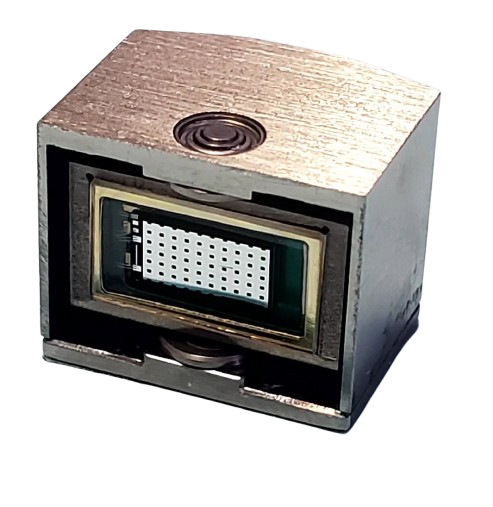
View specifications ↓The original IFM page’s close-up of the projector package and its optical opening, showing the hardware behind the projection demonstration.
Visual demonstration · No audioThe demonstration moves from the projector hardware to a projected image. IFM synchronizes small mirror units to create a larger effective aperture for laser beam scanning displays.
Visual demonstration · No audioValues reflect published prototypes and typical configurations. Aperture, scan angle, coatings, sensing, packaging and drive can be tailored. Final performance depends on the application.
| Parameter | Value / notes |
|---|---|
| Effective optical aperture | 15 mm² typical |
| Resonant frequency | 18 / 20 / 22 kHz (min / typ / max) |
| Fast-axis optical scan angle | 30° p-p typical |
| Reflected-beam divergence | 2 mrad typical; 3 mrad max at 635 nm |
| Fast-axis drive power | 0.8 mW typical at typical optical angle |
| Fast-axis drive voltage | 110 Vpp typical |
| Reflectivity | 97% typical, 450–650 nm |
| Hybrid slow-axis optical angle | 50° typical |
Share the aperture, scan pattern, wavelength band and operating environment your system needs. We can discuss the configuration and available technical details.
Contact the team ↗